Germany
ger-20260507-s-001
page = 1
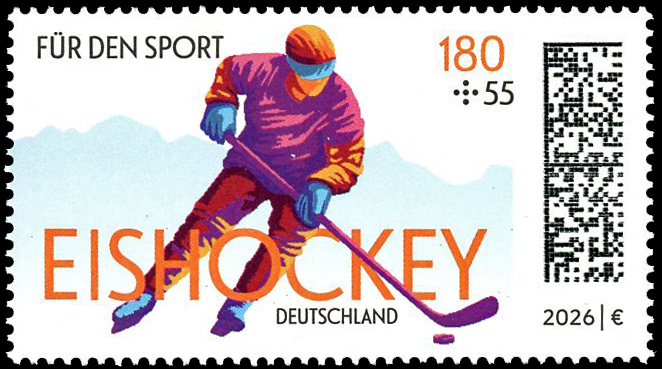
Click here for higher resolution image
Occasion: 2026 Winter Olympics, 2026, Milan/Cortina d'Ampezzo, Italy
Width: 55 mm
Height: 30 mm
Perforation: Perforated 14.00 x 14.00
Printing method: Offset
Printer: Bagel Security-Print GmbH, Mönchengladbach, Germany
Creative team:
Bettina Walter, Designer
Location: Ice Hockey Volume XLVIII
Stamp ID = 9671
This stamp has a .55 Euro surcharge and is issued for the special stamp series "FÜR DEN SPORT". The Federal Ministry of Finance supports the "German Sports Aid Foundation." Since 1968, the additional revenue has been used to provide funding for social initiatives and projects in the field of youth and elite sports.
From Linn's "Stamp Issuing Entities Of The World" page.
Germany (1872-)
Stamp-issuing status: active; Population: 84,068,216.State in central Europe. Traditionally divided into numerous petty sovereignties, German unification began with the growth of Prussian power in the 19th century. French occupation during the Napoleonic Wars brought the dissolution of many of the smaller states and stimulated German nationalism, which looked more and more to Prussia for leadership. The German Confederation (1815-66) and North German Confederation (1867-71) paved the way for unification. The Franco-Prussian War of 1870-71 brought the German states (except Austria) together to defeat France, and the German victory saw the creation of the German Empire with the Prussian king as emperor.. . .
In April 1945, soon after Hitler's suicide, Germany surrendered unconditionally. Germany lost all territory acquired after 1919, as well as much of that which had been left to it after its defeat in World War I. The country was divided into four zones of occupation, administered by the United States, Great Britain, France and the Soviet Union. In 1949, the German Federal Republic was formed from the three western zones, and the German Democratic Republic was created out of the Soviet zone.
. . .
With the fall of the East German communist regime in 1989, reunification proceeded rapidly, and by the end of 1990 the German Federal Republic and the German Democratic Republic had again become one nation.